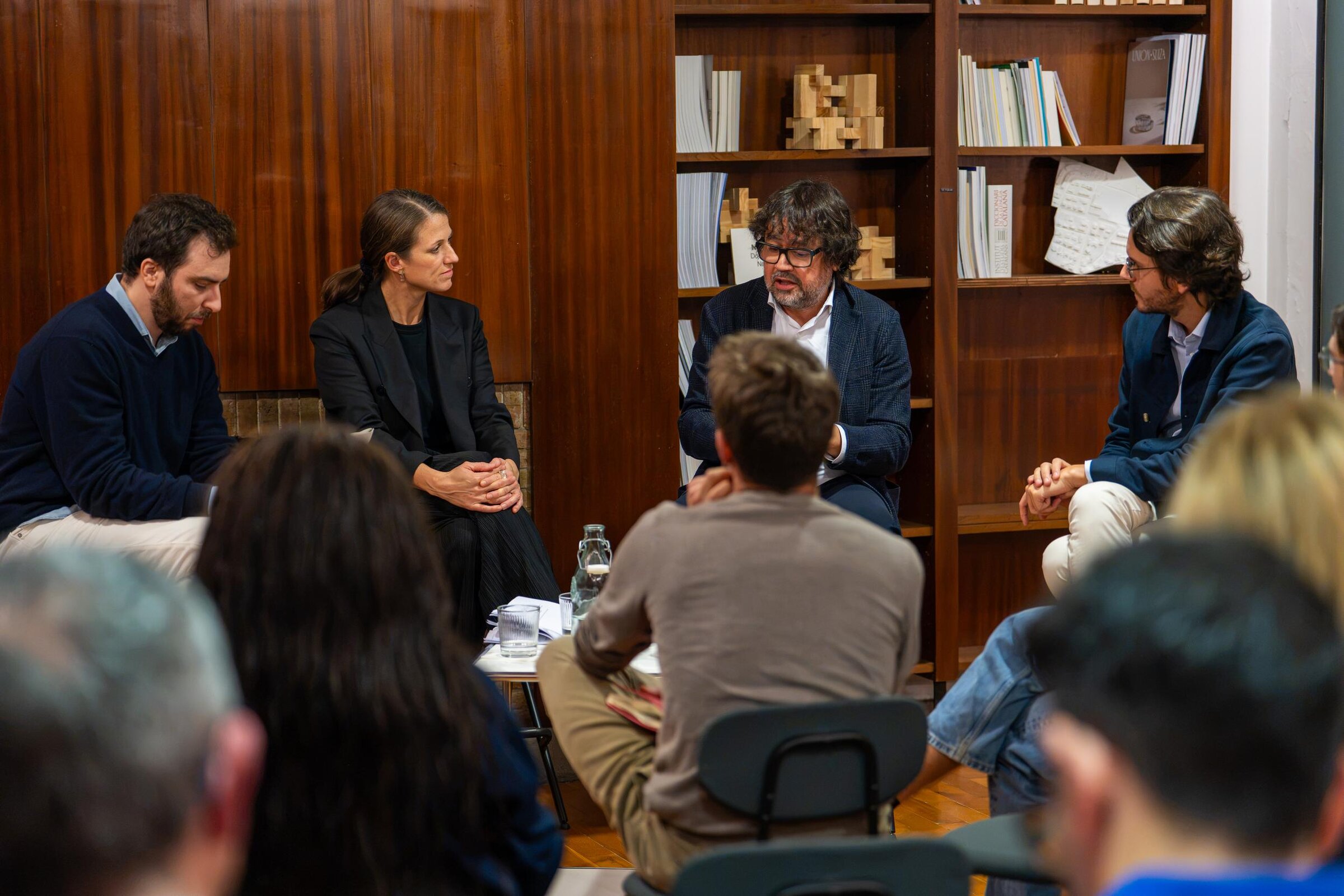
Technology in the city should never be an end in itself, but rather a tool in the service of the street – and of those who build it, maintain it and bring it to life. Guided by this conviction, we hosted a conversation between leading voices in urban innovation, entitled ‘Belloch: Architecture, Nature and Technology in Dialogue’, as part of the programme of events for Barcelona World Capital of Architecture.

The city has always been the stage on which the technological advances that have shaped our societies have unfolded. Although today it can seem as if only data – and everything that flows from it – counts as technological progress, dominating the urban debate, digitalisation is merely the latest in a long series of waves. Before it came concrete, glass, steel structures and underground transport. Though they are now part of our urban imagination, each of them revolutionised the way we live together in the city.
This latest wave, which William J. Mitchell dubbed the ‘City of Bits’, has swung back and forth like a pendulum.
At first, technology was a banner that cities had to raise to prove they were at the cutting edge of urban innovation. This gave rise to a kind of imperative to digitise anything deemed suitable. Later, once it had become clear that technology alone was no solution, its role in new urban management processes was curtailed. Today, aware of the limitations of both stances, we are turning our attention back to it – this time with the perspective needed to tackle the social, economic and environmental challenges our cities face.
“Urban planning needs greater input from sociology and the study of how spaces are used in order to deepen our understanding of space.”
Cristina Garrido · Anteverti

While acknowledging that much research remains to be done, the speakers were convinced that technology must serve a broad strategy that puts people at its heart.
That strategy must be built on specific objectives. These make it possible to move beyond the ideological framing of each initiative, assess it more rigorously and understand why, to what end and for whom we are acting.
The aim is not to accumulate data, but to gather the information that actually helps to improve public space.
“If we know why we’re doing it and have the data we need, we’ll be able to assess whether the objectives behind the project have been met: whether people play more, whether electricity consumption has changed, whether the temperature has gone up or down, whether the paving slabs last longer or not, or whether a different type of paving would have been better.”
Ricard Font · BIMSA


“Innovation demands courage, room to experiment, clear ethical boundaries and thinking about maintenance from the out.”
Nicolás Capo · urbidermis
hank you to everyone who joined us.
