Hello friend,
-
Login or register
Commercial network
Path to responsibility
Back to Responsibility
Analysed Impact Categories
The life-cycle analyses have been performed using the guidelines ISO 14040 (Life cycle analysis – Principles and framework) and ISO 14044 (Environmental management – Life cycle assessment – Requirements and guidelines).
Acidification
Indicator of potential acidification of soils and water (increase in pH). Associated with the death of plantlife, low crop yields, soil infertility, contamination of water-based ecosystems, etc.
Method and unit
EF v3.1 | acidification | accumulated excess (AE) (mol H+-Eq)
Climate Change
Indicator of greenhouse gas emissions (GHG) which contribute to climate change in the atmosphere. Associated with the increase in temperatures and changes in climate patterns due to the greenhouse effect.
Method and unit
IPCC 2021 | climate change | global warming potential (GWP100) (kg CO2-Eq)
Ecotoxicity
Indicator that measures the toxic effects of chemical compounds in the ecosystem. Associated with the bioaccumulation of toxic compounds, the death of living organisms and the alteration or breakdown of ecosystems.
Method and unit
USEtox | ecotoxicity | total (CTU)
Depletion of Fossil Fuels
Indicator of the depletion of non-renewable fossil fuels. Associated with the concern that these limited energy resources will not be available in the future based on current consumption patterns.
Method and unit
CML v4.8 2016 | energy resources: non-renewable | abiotic depletion potential (ADP): fossil fuels (MJ)
Eutrophication
Indicator of the enrichment of the freshwater ecosystem with nutrients. Associated with the excessive growth of algae in bodies of water, a lack of oxygen and the death of aquatic organisms.
Method and unit
CML v4.8 2016 | eutrophication (kg PO4-Eq)
Land Use for Agriculture
Indicator of the use and transformation of land with agricultural potential for other purposes, such as forests, roads, industrial areas and mineral extraction, among others.
Method and unit
ReCiPe 2016 v1.03, midpoint (H) | land use | use of agricultural land (LOP) (m2 cultivo-Eq)
Depletion of Minerals and Metals
Indicator of depletion of metal and mineral resources. Associated with the concern that these extremely scarce, non-renewable resources will not be available in the future.
Method and unit
CML v4.8 2016 | material resources: metals/minerals | abiotic depletion potential (ADP): elements (last reserves) (kg Sb-Eq)
Water Use
Analysis of water use in transformation processes. Water use can stem from a wide range of sources, from its direct use in production processes to its indirect use in hydroelectric power.
Method and unit
ReCiPe 2016 v1.03, midpoint (H) | water consumption potential (WCP) (m3 H2O)
Regenerative Agriculture

In regenerative agriculture, preserving and restoring the soil is considered a key factor for a healthy ecosystem. The aim is to regenerate, stimulate and maintain the soil’s fertility and biodiversity, increase water infiltration and retention and avoid erosion through respectful techniques in agriculture, livestock farming and forest management.
Our relations
Members of
- United Nations Global Compact
Sponsors of
- FAD (Industrial Design Association)
- BCD (Barcelona Center of Design)
- AEP (Spanish Association for Landscape Architecture Professionals)
- ACPET (Catalan Association of Sports and Tourist Ports)
Academic collaborations with
ETSAB (Barcelona School of Architecture)
EINA (University of Art and Design of Barcelona)
ELISAVA (Barcelona School of Design and Engineering)
ESADE (Business School)
Members of
European Forest Institute
Barcelona Global
LAF (Lanscape Architecture Foundation)
CEISP (Spanish Lighting Committee)
ANFALUM (National Association of Lighting Manufacturers)
AIDIME (Institute of Technology)
Our Team
We are committed to monitoring, analysing and adopting the measures necessary to enhance people’s wellbeing. So far this year, we have run internal training programmes on the principles and commitments laid out in our Code of Ethics, which aims to promote good working conditions and continual improvement. They include:
Parity
Increase the number of women occupying senior positions and in governing bodies.
Monitor, analyse and mitigate the wage gap.
Arrange with expert organisations for the analysis, assessment and monitoring of our improvements.
Urbidermis
50%
Men
50%
Women
Interculturalism
Increase the variety of cultures and nationalities in our offices.
Create a communication policy committed to interculturalism.
Arrange with expert organisations for the analysis, assessment and monitoring of our improvements.
Belloch Forestal
94%
Men
6%
Women

Responsible Design
We advocate a sound material culture and adhere to high standards in terms of material quality and aesthetic restraint.
We place particular emphasis on timeless product design and choose responsible materials that age well, implementing policies that increase their durability or allow them to enjoy a second life.
Materials
We look for suitable materials that require minimal maintenance. The resistance, quality and finishes of our products require low-cost maintenance.

Aluminium
Recycled and recyclable
92%
Recycled in injected lamps
67%
Recycled in cast aluminium furniture
100%
Recyclable
Steel
Recycled and recyclable
16%
Recycled (depending on variations in the market)
100%
Recyclable
Wood
From sustainable forests
100%
FSC 100% certified tropical wood
100%
100% PEFC European wood
Experience
Our goal is to ensure that each product has the right lighting. Our project department analyses the required light levels, including lighting temperature and brightness, in order to strike the perfect balance between comfort, citizen safety and respect for the biological rhythms of the flora and fauna.

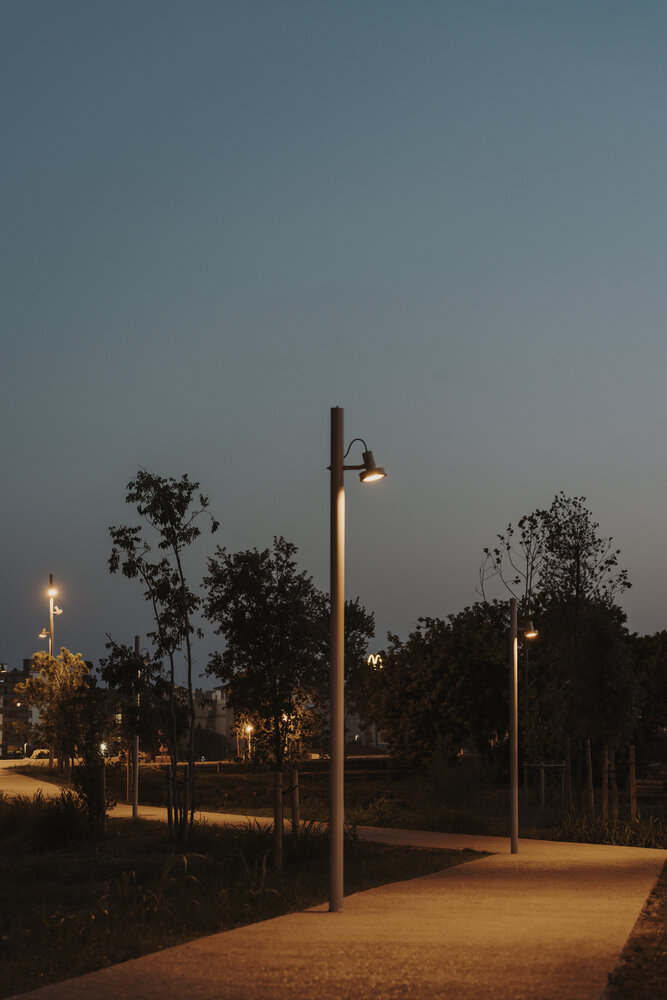

Timelessness
We only take on projects that reflect our principles . Formal simplicity makes for durable design. And we ensure that the technology and materials we use are updated in line with the new opportunities their evolution offers.
Rama: a timeless product
Renovation of Light Sources
Through our Retrofit programme we ensure that lamps with LED technology are updated in order to optimise light performance: energy adjustments, energy savings and longer service life (>100,000 hours).
Through our Retrofit programme we ensure that lamps with LED technology are updated in order to optimise light performance: energy adjustments, energy savings and longer service life (>100,000 hours).

First version. A stylised lighting element.

We reduce weight to facilitate assembly.

We prioritise aluminium over plastic.

Introducing LED.

Heat sink built into the body. Four accessories for its installation.
Local Production
Since our founding in 1985 we have benefited from a broad pool of local suppliers that help us to ensure quality control, effective monitoring and logistical efficiency.
We have licence partners in faraway countries to minimise the carbon footprint of our products. The products are designed in Barcelona and produced locally in the United States, New Zealand and Australia, following our Supplier Code requirements.
Unveiled in 2021, our Supplier Code outlines and defines our social and environmental responsibility standards.
77% of our suppliers comply with the most demanding requirements of our Supplier Code.
We make 89% of our purchases from suppliers located less than 200 km from our headquarters.

We are audited
Excellent intentions are not enough; our efforts need to be audited externally. These international audits verify the traceability of our materials and certify our good practice.
All our products comply with applicable European Directives and Standards, authorizing free circulation within the European Economic Area (EEA). We also comply with the Electromagnetic Compatibility (EMC) Directive and the Low Voltage Directive. We certify with ENAC-accredited external laboratories.
The certification guarantees the design, testing, evolution, manufacturing and assembling of approved products, in accordance with the applicable safety standards in the U.S. and Canada. Our light fixtures are classified according to the UL Standards for different environments.
We comply with the Restriction of Hazardous Substances (RoHS) Directive for electrical and electronic components. We also comply with the Waste Directive (RAEE/WEEE) for respectful waste management.
All of our wood products comply with the Chain of Custody Certifications granted by non-profit organizations, the Forest Stewardship Council® and the Programme for the Endorsement of Forest. We certify both sources through accredited external entities, ensuring the supply contributes to maintaining biodiversity, productivity and ecological processes, benefits local populations and society, and does not profit at the expense of forests, ecosystems and society.
All of our wood products comply with the Chain of Custody Certifications granted by non-profit organizations, the Forest Stewardship Council® and the Programme for the Endorsement of Forest. We certify both sources through accredited external entities, ensuring the supply contributes to maintaining biodiversity, productivity and ecological processes, benefits local populations and society, and does not profit at the expense of forests, ecosystems and society.
Urbidermis is the first company in the world to certify its urban furniture products with Cradle to Cradle®, a leadership and sustainability commitment it has maintained since 2009.
Cradle to Cradle® is the global standard that certifies products designed according to the principles of advanced sustainability and the circular economy. It evaluates each product in five key categories: material health, circularity, renewable energy and carbon management, water and soil stewardship, and social fairness.
Its goal is not only to reduce environmental impact but to generate a positive effect. The certification ensures that the products are designed to circulate indefinitely, so that their materials can re-enter biological or technical cycles without losing quality or generating waste.
We comply with the accessibility standards established by the Americans with Disabilities Act (ADA). Our products are designed to ensure inclusion and usability for people with diverse abilities, promoting accessible and equitable environments.
This approval ensures compliance with the requirements of the WRAS Regulations and Standards, which aim to prevent the waste, misuse, illicit consumption and contamination of the water supply.
We are ISO 9001 certified.
We comply with international quality standards, which guarantee the management and continuous improvement of our products and services, aiming to enhance customer satisfaction.
We hold ISO 14001 certification.
We ensure our commitment to environmental management and the reduction of our impact, as well as the identification and prevention of environmental risks associated with both our activities and products.
A global certification that recognizes companies committed to high standards of sustainability, responsibility, and transparency. B Corp evaluates an organization’s performance in five areas: governance, workers, community, environment, and customers. Its purpose is not only to minimize negative impact, but to maximize positive impact. The certification confirms that the company operates ethically, generates social and environmental value, and balances economic profit with the well-being of people and the planet.
We have recently received a grant from the Spanish Chamber of Commerce as part of the Recovery, Transformation and Resilience Plan financed by the EU with NextGeneration funds, through the aid program for obtaining international quality certifications. This grant reinforces our track record in complying with the highest standards in design, production, and environmental management.



Our Offices
We are based in Parc de Belloch, an extensive 200-hectare estate near Barcelona, where there is also a 30-hectare tree nursery: Belloch Forestal. Our headquarters comprises a knowledge park, where striking the balance between people, the city and the planet is a priority.
Parc de Belloch


Carbon Footprint
We are committed to achieving carbon neutrality by 2025.
Temp.
Since 2019 we have been monitoring our footprint on a yearly basis, which we have been able to reduce by 45%.
Self-Sufficiency
By 2030, we aim to be self-sufficient in energy, water and food consumption.
Temp.
We have installed solar panels that produce 24% of the total energy consumed on the property. Our commitment is to reach 40% by
Temp.
We have a rainwater collection system and have reduced consumption both in the offices (20%) and the nursery (25% per tree) since
Temp.
We are improving the soil’s fertility to allow for a biointensive vegetable garden for 2030, which will enable us to be food self-sufficient.
Sustainable Mobility
We want to minimise the environmental and territorial impact of our daily commute to the offices.
Temp.
43% of our vehicle fleet is electric and we have 17 free charging stations for electric cars.
Temp.
We offer a daily taxi service to the local train station.
Temp.
We have developed an app that promotes the shared use of private cars.
Tree Nursery

Integrated Pest Control
We carry out pest and disease control. Since 2019, we have reduced our use of pesticides and fungicides by 50%.
We use and generate living soils
14% of our nursery is managed through regenerative agriculture, enhancing the soil’s fertility and biodiversity.
Recycled and Reusable Planters
In our tree nursery, 80% of our containers have been reused since 2009. By providing trees without planters, we avoid introducing 13 Tn of plastic onto the market every year.
We Protect Biodiversity

Roe deer (Capreolus capreolus)

Red fox (Vulpes vulpes)

European rabbit (Oryctolagus cuniculus)

European badger (Meles meles)

Genet (Genetta genetta)

Wild boar (Sus scrofa)
Images captured by camera traps set up in our forests.
Located at a unique site, surrounded by nature and fully aware of the estate’s immense value as a biological corridor, we are committed to preserving and enhancing ecosystem biodiversity.
Monitoring
We are participants in the SEMICE project, which monitors the evolution of small common mammal populations to assess the state of ecosystems at local and global levels. So far, we have carried out three campaigns with 36 focus groups and over 30 participants.
Sustainable Management
We have PEFC sustainable forest management certification in all our forests (88.31 ha), promoting the preservation of biodiversity and fostering the social economy, circularity and sustainable development.
Awareness Raising
We run activities to raise awareness and promote the estate’s biodiversity with all staff members and their families.
Social Impact

We promote knowledge, giving talks and participating in debates.
We only work with protectable industrial design.
We publish books on management, urbanism, design and woodland management.
We donate trees to promote the rewilding of school playgrounds.

Diversity and Equity
We value knowledge, embrace cultural diversity and celebrate the differences that make us human.
Training and Talent
We support the personal growth of our teams through training programmes.
- We organise in-house training to strengthen personal and collective capabilities.
- We finance 33% of the cost of external training linked to a given professional position and facilitate work-study compatibility.
- We promote the development of new talent through internship agreements with leading universities.
Decent Working Conditions
We ensure decent working conditions in terms of pay equality for work of the same value for all people.
Physical, Mental and Emotional Wellbeing
We offer our teams the use of vegetable gardens, a healthy and season-based canteen with subsidised menus, remote working days and private medical insurance.

Code of Ethics
We establish guidelines beyond the strict compliance with the law. We are laying the foundations for the development of shared moral values and look to build long-lasting relations built on trust.
Open Inbox
The Open Inbox is the mechanism implemented by Urbidermis to allow suspected breaches of our Code of Ethics to be reported or where suggestions can be made for making improvements.