Degree of protection of light fixtures against the penetration of solids and liquids.
IEC 529 - EN 60529 Standard.
(First digit – Solids / Second digit – Liquids)
IP55
5. Protected against dust penetration.
5. Protected against jets of water.
IP65
6. Hermetically protected against dust.
5. Protected against jets of water.
IP66
6. Hermetically protected against dust.
6. Protected against sea swells and similar.
Degree of protection against mechanical impacts provided by the enclosure.
In accordance with EN 50102.
IK08 (0.5 J), IK09 (1 J), IK10 (2 J).
CLASS I.
Functional insulation in all its parts and ground connection.
CLASS II.
Double reinforced insulation to avoid voltage in exposed metal parts.
Product certificates
All our products comply with applicable European Directives and Standards, authorizing free circulation within the European Economic Area (EEA). We also comply with the Electromagnetic Compatibility (EMC) Directive and the Low Voltage Directive. We certify with ENAC-accredited external laboratories.
The certification guarantees the design, testing, evolution, manufacturing and assembling of approved products, in accordance with the applicable safety standards in the U.S. and Canada. Our light fixtures are classified according to the UL Standards for different environments.
We comply with the Restriction of Hazardous Substances (RoHS) Directive for electrical and electronic components. We also comply with the Waste Directive (RAEE/WEEE) for respectful waste management.
Analysed Impact Categories
The life-cycle analyses have been performed using the guidelines ISO 14040 (Life cycle analysis – Principles and framework) and ISO 14044 (Environmental management – Life cycle assessment – Requirements and guidelines).
Acidification
Indicator of potential acidification of soils and water (increase in pH). Associated with the death of plantlife, low crop yields, soil infertility, contamination of water-based ecosystems, etc.
Method and unit
EF v3.1 | acidification | accumulated excess (AE) (mol H+-Eq)
Climate Change
Indicator of greenhouse gas emissions (GHG) which contribute to climate change in the atmosphere. Associated with the increase in temperatures and changes in climate patterns due to the greenhouse effect.
Method and unit
IPCC 2021 | climate change | global warming potential (GWP100) (kg CO2-Eq)
Ecotoxicity
Indicator that measures the toxic effects of chemical compounds in the ecosystem. Associated with the bioaccumulation of toxic compounds, the death of living organisms and the alteration or breakdown of ecosystems.
Method and unit
USEtox | ecotoxicity | total (CTU)
Depletion of Fossil Fuels
Indicator of the depletion of non-renewable fossil fuels. Associated with the concern that these limited energy resources will not be available in the future based on current consumption patterns.
Method and unit
CML v4.8 2016 | energy resources: non-renewable | abiotic depletion potential (ADP): fossil fuels (MJ)
Eutrophication
Indicator of the enrichment of the freshwater ecosystem with nutrients. Associated with the excessive growth of algae in bodies of water, a lack of oxygen and the death of aquatic organisms.
Method and unit
CML v4.8 2016 | eutrophication (kg PO4-Eq)
Land Use for Agriculture
Indicator of the use and transformation of land with agricultural potential for other purposes, such as forests, roads, industrial areas and mineral extraction, among others.
Method and unit
ReCiPe 2016 v1.03, midpoint (H) | land use | use of agricultural land (LOP) (m2 cultivo-Eq)
Depletion of Minerals and Metals
Indicator of depletion of metal and mineral resources. Associated with the concern that these extremely scarce, non-renewable resources will not be available in the future.
Method and unit
CML v4.8 2016 | material resources: metals/minerals | abiotic depletion potential (ADP): elements (last reserves) (kg Sb-Eq)
Water Use
Analysis of water use in transformation processes. Water use can stem from a wide range of sources, from its direct use in production processes to its indirect use in hydroelectric power.
Method and unit
ReCiPe 2016 v1.03, midpoint (H) | water consumption potential (WCP) (m3 H2O)

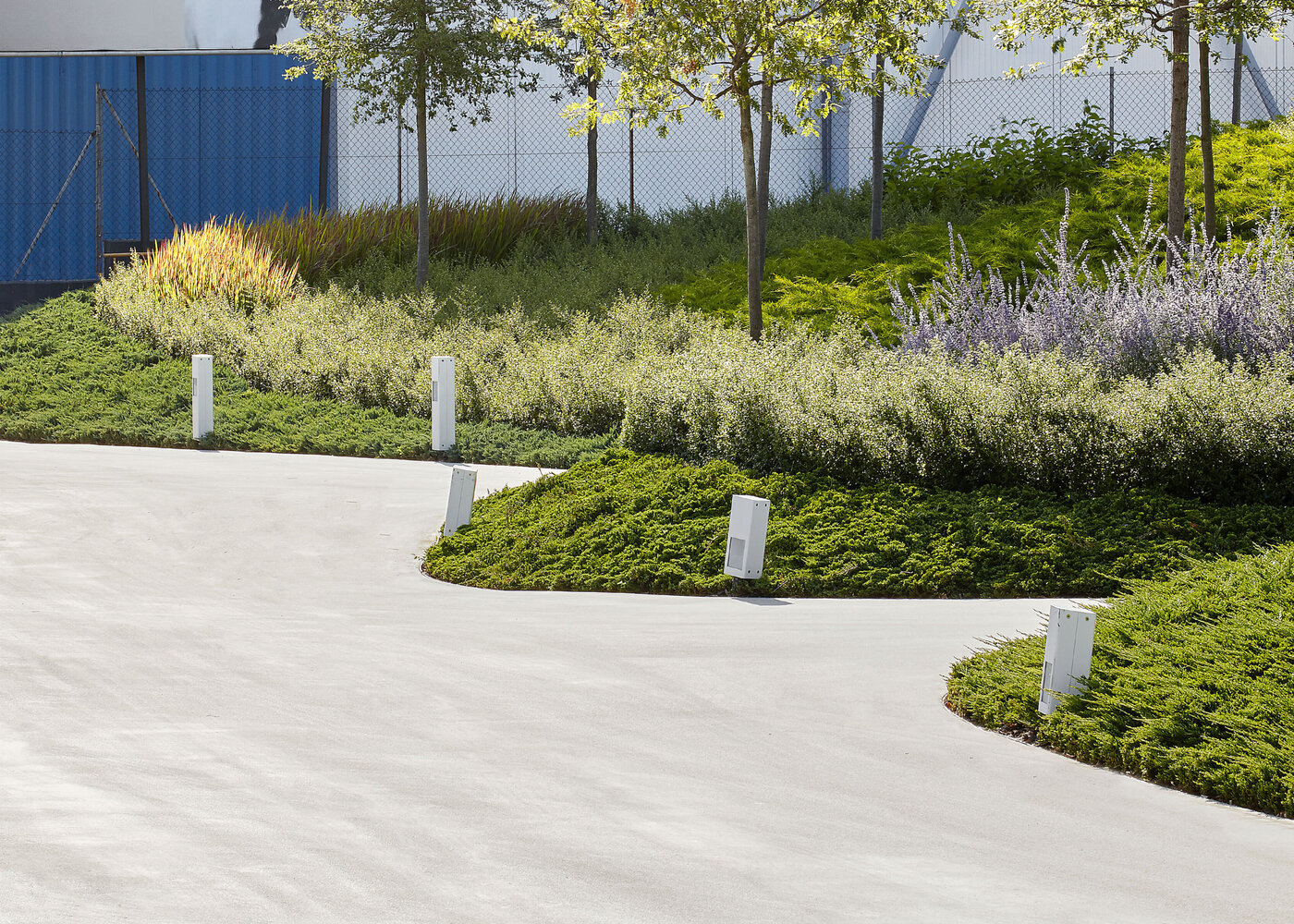


A window of light
With pure geometric shapes in constant interaction, the light windows of the Skyline pathway lights, which are positioned at different heights, provide lighting that identifies the presence of pedestrians without intruding. These qualities allow spaces to be delineated, and they structure routes, combining quality and strength.
-
Pathway light made of anodised aluminium plate, with an internal reflector in die-cast EN-AC-44100 aluminium, an AISI 304 stainless steel base and a powder-coated finish.
-
Tempered optical glass diffuser.
-
A2 stainless steel hardware.

Light grey

Medium grey

Dark grey
The colours shown are purely indicative.
Other colours are available upon request.
Check finishes for marine environments.
System power (W)
High efficiency optical unit
- 4 LEDs 1x6W
- 8 LEDs 2x6W
Operating current (mA)
- 350
Colour temperature (K)
- 3000 CRI min80
- 2700 CRI min80
Service life
TM21 L70 (10k) > 60,000 h.
Pathway

Ground washer
Area Beam

- Recessed model: Installed with a recessed base fixed to a concrete block with four anchor bolts. Includes a groove for electrical connection 10 cm
below the level of the pavement. - Surface-mounted model: Installed with a base fixed directly to the pavement with four anchor bolts.
- The element is supplied assembled.
- Instructions and hardware included.
- Includes pressure compensation valve.
- Clean using pH-neutral, alcohol-free, and non-abrasive cleaning products.

CE

UL

RoHs

IP55 Luminaire

IP66

IK08

Clase I
37 cm pathway light: 5
81 cm pathway light: 10
*Approximate weight without packaging (kg)

